Clear Line Prints · Shop on Zazzle · Shop on TeePublic · Shop on Threadless · Pinterest · YouTube
Home › Chart guides › Whiskey Styles Guide
What legally makes a whisky a Scotch or a bourbon? This guide summarises the rules for Scotch, American, Irish, Japanese and Canadian whiskies, with the typical character of each style and of the Scotch regions.
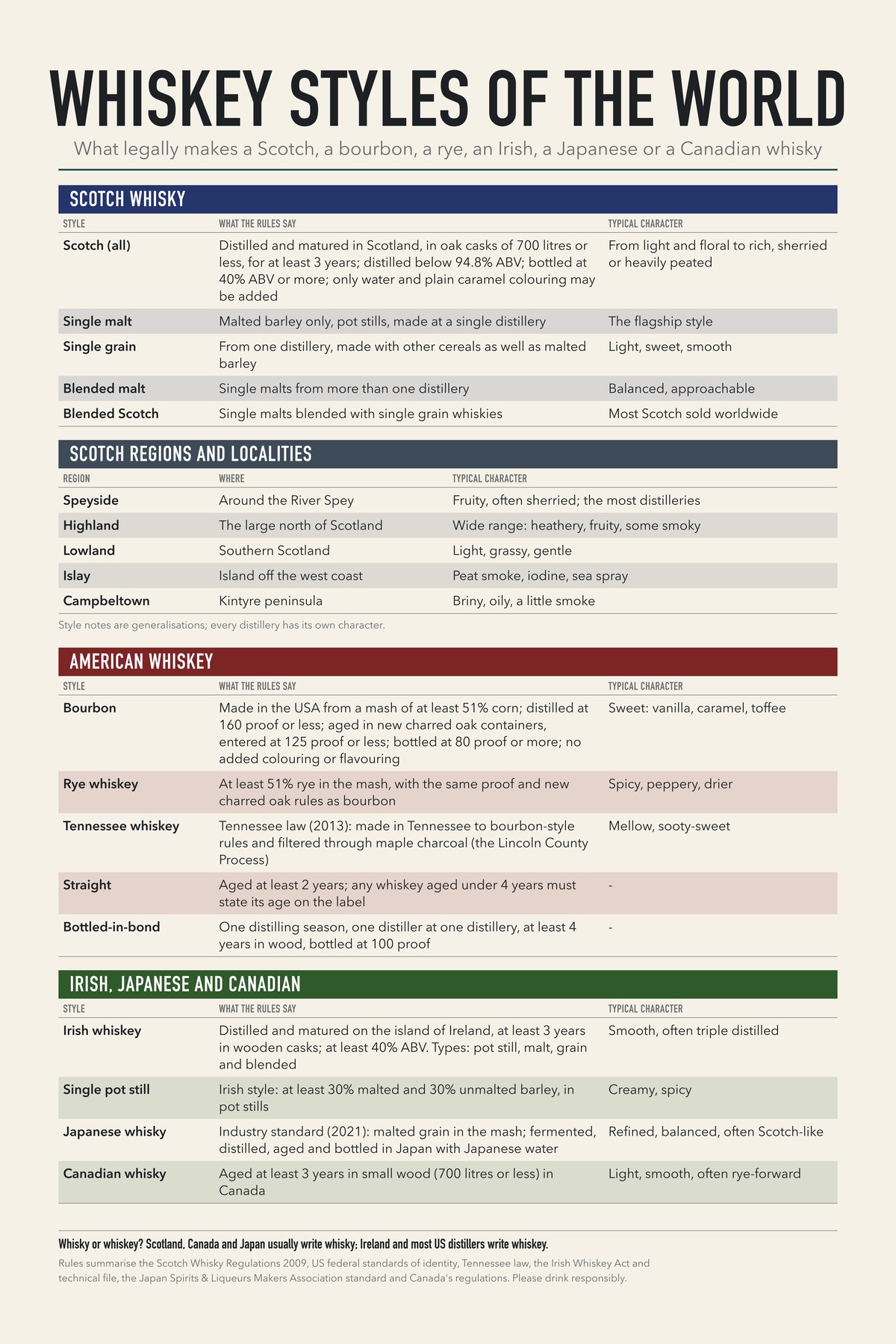
This chart is on its way to our print shops. Our posters are listed on Zazzle, TeePublic and Threadless (links at the top of this page); browse the kitchen and classroom charts to see the ones already available.
What legally makes a Scotch, a bourbon, a rye, an Irish, a Japanese or a Canadian whisky.
| Style | What the rules say | Typical character |
|---|---|---|
| Scotch (all) | Distilled and matured in Scotland, in oak casks of 700 litres or less, for at least 3 years; distilled below 94.8% ABV; bottled at 40% ABV or more; only water and plain caramel colouring may be added | From light and floral to rich, sherried or heavily peated |
| Single malt | Malted barley only, pot stills, made at a single distillery | The flagship style |
| Single grain | From one distillery, made with other cereals as well as malted barley | Light, sweet, smooth |
| Blended malt | Single malts from more than one distillery | Balanced, approachable |
| Blended Scotch | Single malts blended with single grain whiskies | Most Scotch sold worldwide |
| Region | Where | Typical character |
|---|---|---|
| Speyside | Around the River Spey | Fruity, often sherried; the most distilleries |
| Highland | The large north of Scotland | Wide range: heathery, fruity, some smoky |
| Lowland | Southern Scotland | Light, grassy, gentle |
| Islay | Island off the west coast | Peat smoke, iodine, sea spray |
| Campbeltown | Kintyre peninsula | Briny, oily, a little smoke |
Style notes are generalisations; every distillery has its own character.
| Style | What the rules say | Typical character |
|---|---|---|
| Bourbon | Made in the USA from a mash of at least 51% corn; distilled at 160 proof or less; aged in new charred oak containers, entered at 125 proof or less; bottled at 80 proof or more; no added colouring or flavouring | Sweet: vanilla, caramel, toffee |
| Rye whiskey | At least 51% rye in the mash, with the same proof and new charred oak rules as bourbon | Spicy, peppery, drier |
| Tennessee whiskey | Tennessee law (2013): made in Tennessee to bourbon-style rules and filtered through maple charcoal (the Lincoln County Process) | Mellow, sooty-sweet |
| Straight | Aged at least 2 years; any whiskey aged under 4 years must state its age on the label | - |
| Bottled-in-bond | One distilling season, one distiller at one distillery, at least 4 years in wood, bottled at 100 proof | - |
| Style | What the rules say | Typical character |
|---|---|---|
| Irish whiskey | Distilled and matured on the island of Ireland, at least 3 years in wooden casks; at least 40% ABV. Types: pot still, malt, grain and blended | Smooth, often triple distilled |
| Single pot still | Irish style: at least 30% malted and 30% unmalted barley, in pot stills | Creamy, spicy |
| Japanese whisky | Industry standard (2021): malted grain in the mash; fermented, distilled, aged and bottled in Japan with Japanese water | Refined, balanced, often Scotch-like |
| Canadian whisky | Aged at least 3 years in small wood (700 litres or less) in Canada | Light, smooth, often rye-forward |
Whisky or whiskey? Scotland, Canada and Japan usually write whisky; Ireland and most US distillers write whiskey.
Rules summarise the Scotch Whisky Regulations 2009, US federal standards of identity, Tennessee law, the Irish Whiskey Act and technical file, the Japan Spirits & Liqueurs Makers Association standard and Canada's regulations. Please drink responsibly.