Clear Line Prints · Shop on Zazzle · Shop on TeePublic · Shop on Threadless · Pinterest · YouTube
Home › Chart guides › Essential Knots Chart
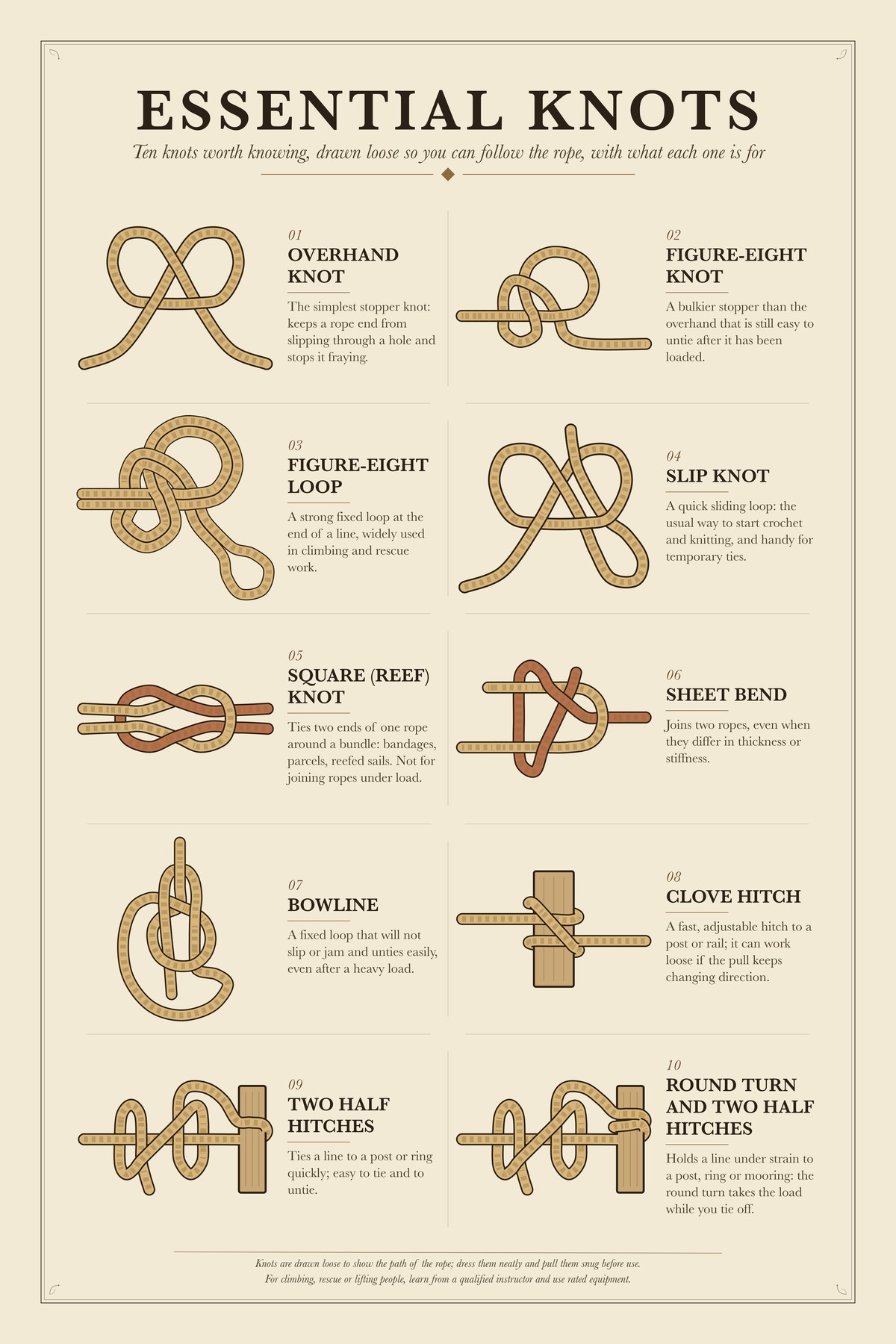
Ten knots cover most everyday jobs, from stopping a rope end to tying a boat to a post. This chart lists the overhand, figure-eight, figure-eight loop, slip knot, square knot, sheet bend, bowline, clove hitch, two half hitches and the round turn and two half hitches, with what each is for.
This chart is printed as a poster and art print by our print partners, who make and ship each order. See the poster page.
Ten knots worth knowing, drawn loose so you can follow the rope, with what each one is for.
| # | Knot | What it is for |
|---|---|---|
| 01 | Overhand knot | The simplest stopper knot: keeps a rope end from slipping through a hole and stops it fraying. |
| 02 | Figure-eight knot | A bulkier stopper than the overhand that is still easy to untie after it has been loaded. |
| 03 | Figure-eight loop | A strong fixed loop at the end of a line, widely used in climbing and rescue work. |
| 04 | Slip knot | A quick sliding loop: the usual way to start crochet and knitting, and handy for temporary ties. |
| 05 | Square (reef) knot | Ties two ends of one rope around a bundle: bandages, parcels, reefed sails. Not for joining ropes under load. |
| 06 | Sheet bend | Joins two ropes, even when they differ in thickness or stiffness. |
| 07 | Bowline | A fixed loop that will not slip or jam and unties easily, even after a heavy load. |
| 08 | Clove hitch | A fast, adjustable hitch to a post or rail; it can work loose if the pull keeps changing direction. |
| 09 | Two half hitches | Ties a line to a post or ring quickly; easy to tie and to untie. |
| 10 | Round turn and two half hitches | Holds a line under strain to a post, ring or mooring: the round turn takes the load while you tie off. |
Knots are drawn loose to show the path of the rope; dress them neatly and pull them snug before use.
For climbing, rescue or lifting people, learn from a qualified instructor and use rated equipment.