Clear Line Prints · Shop on Zazzle · Shop on TeePublic · Shop on Threadless · Pinterest · YouTube
Home › Chart guides › Circle of Fifths Chart
The circle of fifths puts the twelve major keys in order so that each step clockwise adds one sharp and each step counter-clockwise adds one flat. Here are all twelve keys with their relative minors and key signatures, the order of sharps and flats, and how to read the circle.
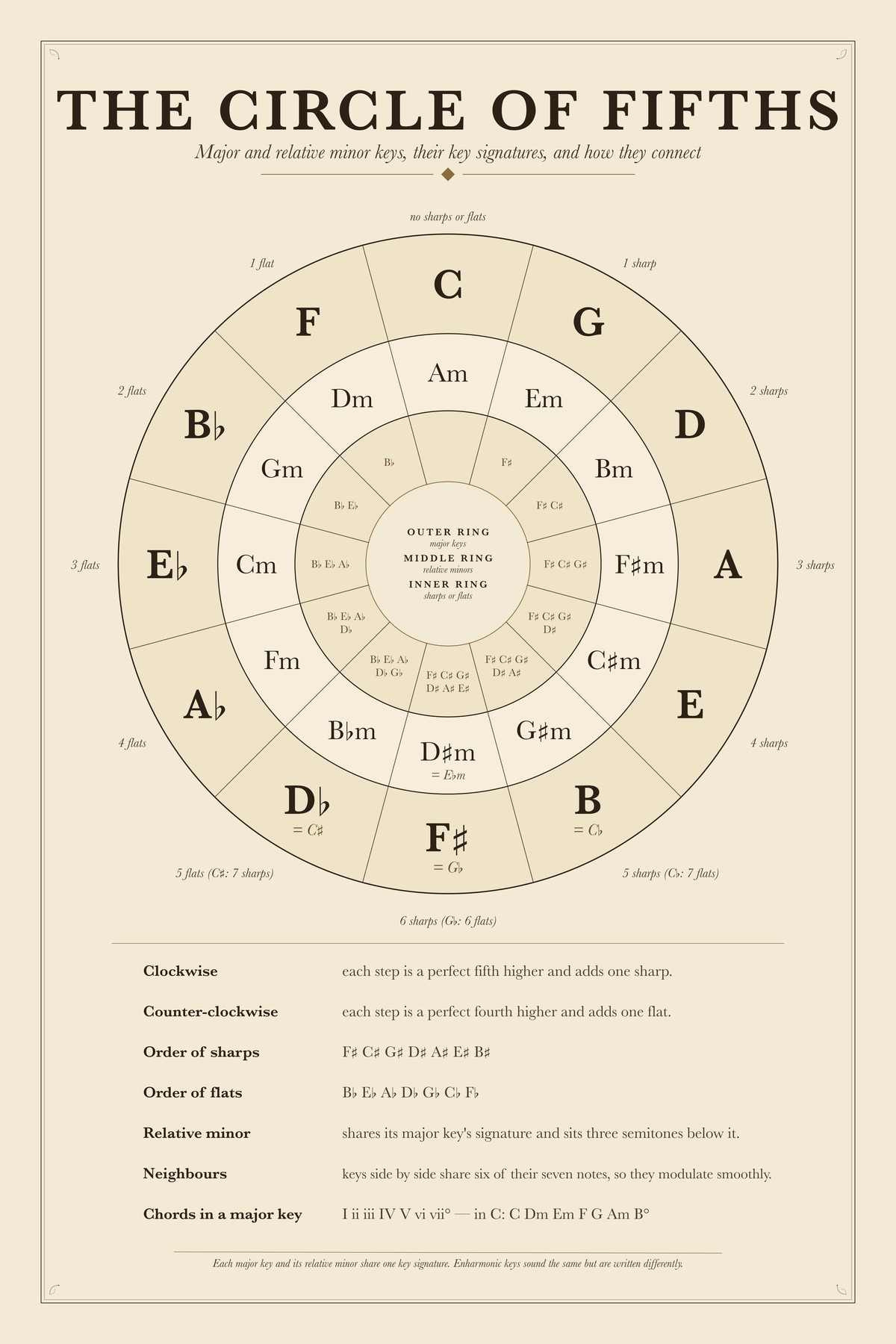
This chart is printed as a poster and art print by our print partners, who make and ship each order. See the poster page.
Major and relative minor keys, their key signatures, and how they connect.
| Major key | Relative minor | Key signature |
|---|---|---|
| C major | A minor | No sharps or flats |
| G major | E minor | 1 sharp: F♯ |
| D major | B minor | 2 sharps: F♯ C♯ |
| A major | F♯ minor | 3 sharps: F♯ C♯ G♯ |
| E major | C♯ minor | 4 sharps: F♯ C♯ G♯ D♯ |
| B major | G♯ minor | 5 sharps: F♯ C♯ G♯ D♯ A♯ |
| F♯ major | D♯ minor | 6 sharps: F♯ C♯ G♯ D♯ A♯ E♯ |
| D♭ major | B♭ minor | 5 flats: B♭ E♭ A♭ D♭ G♭ |
| A♭ major | F minor | 4 flats: B♭ E♭ A♭ D♭ |
| E♭ major | C minor | 3 flats: B♭ E♭ A♭ |
| B♭ major | G minor | 2 flats: B♭ E♭ |
| F major | D minor | 1 flat: B♭ |
| Order | |
|---|---|
| Sharps | F♯ C♯ G♯ D♯ A♯ E♯ B♯ |
| Flats | B♭ E♭ A♭ D♭ G♭ C♭ F♭ |
| Clockwise | each step is a perfect fifth higher and adds one sharp. |
| Counter-clockwise | each step is a perfect fourth higher and adds one flat. |
| Relative minor | shares its major key's signature and sits three semitones below it. |
| Neighbours | keys side by side share six of their seven notes, so they modulate smoothly. |
| Chords in a major key | I ii iii IV V vi vii° — in C: C Dm Em F G Am B° |
Each major key and its relative minor share one key signature. Enharmonic keys sound the same but are written differently.