Clear Line Prints · Shop on Zazzle · Shop on TeePublic · Shop on Threadless · Pinterest · YouTube
Home › Chart guides › Solar System Planets Chart
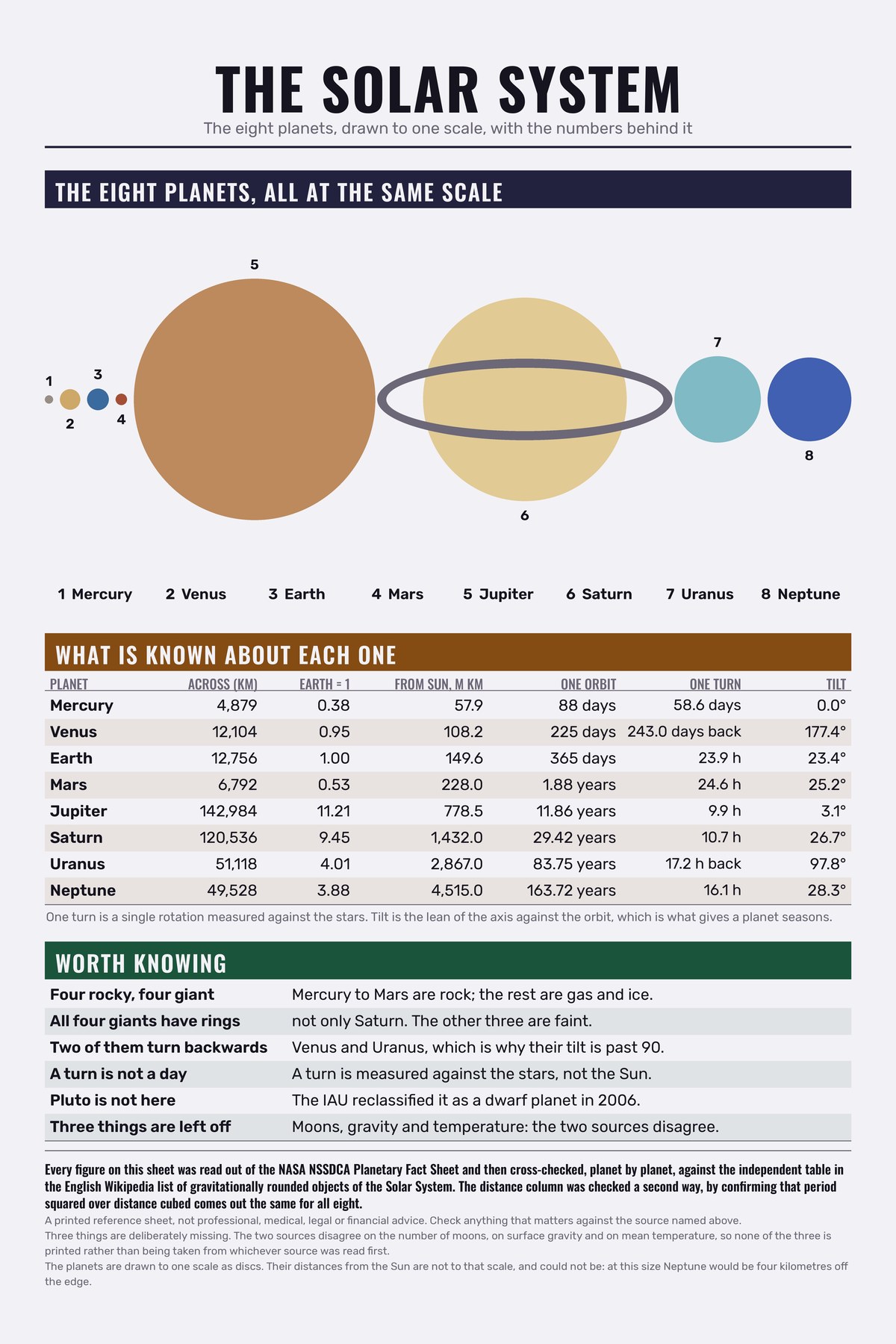
The eight planets from Mercury to Neptune, with how wide each one is, its size compared with Earth, its distance from the Sun, how long one orbit and one turn take, and the tilt of its axis, from the NASA Planetary Fact Sheet.
This chart is on its way to our print shops. Our posters are listed on Zazzle, TeePublic and Threadless (links at the top of this page); browse the kitchen and classroom charts to see the ones already available.
The eight planets, drawn to one scale, with the numbers behind it.
| Planet | Across (km) | Earth = 1 | From Sun, M km | One orbit | One turn | Tilt |
|---|---|---|---|---|---|---|
| Mercury | 4,879 | 0.38 | 57.9 | 88 days | 58.6 days | 0.0° |
| Venus | 12,104 | 0.95 | 108.2 | 225 days | 243.0 days back | 177.4° |
| Earth | 12,756 | 1.00 | 149.6 | 365 days | 23.9 h | 23.4° |
| Mars | 6,792 | 0.53 | 228.0 | 1.88 years | 24.6 h | 25.2° |
| Jupiter | 142,984 | 11.21 | 778.5 | 11.86 years | 9.9 h | 3.1° |
| Saturn | 120,536 | 9.45 | 1,432.0 | 29.42 years | 10.7 h | 26.7° |
| Uranus | 51,118 | 4.01 | 2,867.0 | 83.75 years | 17.2 h back | 97.8° |
| Neptune | 49,528 | 3.88 | 4,515.0 | 163.72 years | 16.1 h | 28.3° |
One turn is a single rotation measured against the stars. Tilt is the lean of the axis against the orbit, which is what gives a planet seasons.
| Four rocky, four giant | Mercury to Mars are rock; the rest are gas and ice. |
| All four giants have rings | not only Saturn. The other three are faint. |
| Two of them turn backwards | Venus and Uranus, which is why their tilt is past 90. |
| A turn is not a day | A turn is measured against the stars, not the Sun. |
| Pluto is not here | The IAU reclassified it as a dwarf planet in 2006. |
| Three things are left off | Moons, gravity and temperature: the two sources disagree. |
Every figure on this sheet was read out of the NASA NSSDCA Planetary Fact Sheet and then cross-checked, planet by planet, against the independent table in the English Wikipedia list of gravitationally rounded objects of the Solar System. The distance column was checked a second way, by confirming that period squared over distance cubed comes out the same for all eight.
The planets are drawn to one scale as discs. Their distances from the Sun are not to that scale, and could not be: at this size Neptune would be four kilometres off the edge.