Clear Line Prints · Shop on Zazzle · Shop on TeePublic · Shop on Threadless · Pinterest · YouTube
Home › Chart guides › Unit Circle Chart
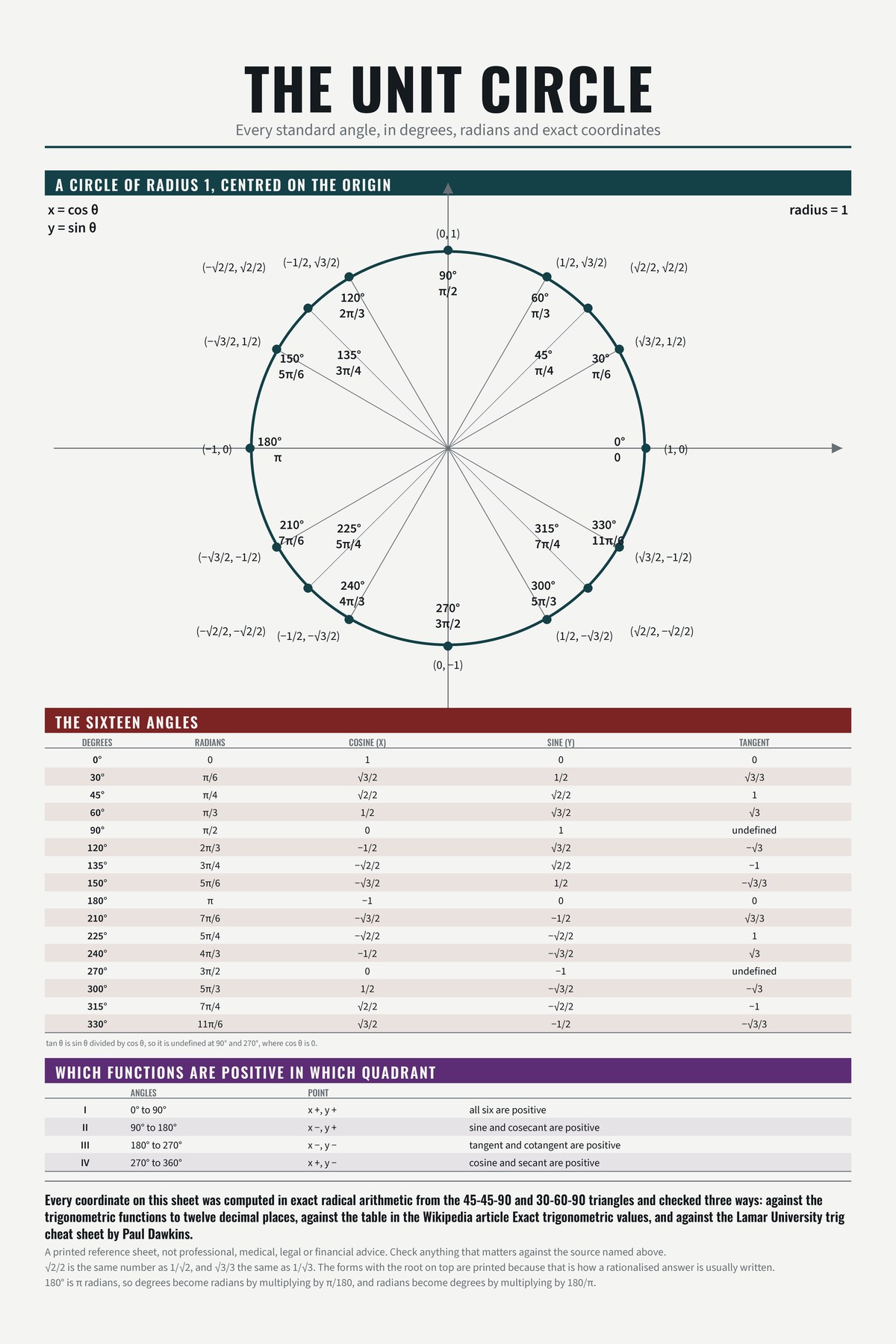
The unit circle is a circle of radius 1 centred on the origin, and the point at each angle gives that angle's cosine and sine. This chart lists all sixteen standard angles in degrees and radians with their exact cosine, sine and tangent, and which functions are positive in each quadrant.
This chart is on its way to our print shops. Our posters are listed on Zazzle, TeePublic and Threadless (links at the top of this page); browse the kitchen and classroom charts to see the ones already available.
Every standard angle, in degrees, radians and exact coordinates.
| Degrees | Radians | Cosine (x) | Sine (y) | Tangent |
|---|---|---|---|---|
| 0° | 0 | 1 | 0 | 0 |
| 30° | π/6 | √3/2 | 1/2 | √3/3 |
| 45° | π/4 | √2/2 | √2/2 | 1 |
| 60° | π/3 | 1/2 | √3/2 | √3 |
| 90° | π/2 | 0 | 1 | undefined |
| 120° | 2π/3 | −1/2 | √3/2 | −√3 |
| 135° | 3π/4 | −√2/2 | √2/2 | −1 |
| 150° | 5π/6 | −√3/2 | 1/2 | −√3/3 |
| 180° | π | −1 | 0 | 0 |
| 210° | 7π/6 | −√3/2 | −1/2 | √3/3 |
| 225° | 5π/4 | −√2/2 | −√2/2 | 1 |
| 240° | 4π/3 | −1/2 | −√3/2 | √3 |
| 270° | 3π/2 | 0 | −1 | undefined |
| 300° | 5π/3 | 1/2 | −√3/2 | −√3 |
| 315° | 7π/4 | √2/2 | −√2/2 | −1 |
| 330° | 11π/6 | √3/2 | −1/2 | −√3/3 |
tan θ is sin θ divided by cos θ, so it is undefined at 90° and 270°, where cos θ is 0.
| Angles | Point | ||
|---|---|---|---|
| I | 0° to 90° | x +, y + | all six are positive |
| II | 90° to 180° | x −, y + | sine and cosecant are positive |
| III | 180° to 270° | x −, y − | tangent and cotangent are positive |
| IV | 270° to 360° | x +, y − | cosine and secant are positive |
Every coordinate on this sheet was computed in exact radical arithmetic from the 45-45-90 and 30-60-90 triangles and checked three ways: against the trigonometric functions to twelve decimal places, against the table in the Wikipedia article Exact trigonometric values, and against the Lamar University trig cheat sheet by Paul Dawkins.
√2/2 is the same number as 1/√2, and √3/3 the same as 1/√3. The forms with the root on top are printed because that is how a rationalised answer is usually written.
180° is π radians, so degrees become radians by multiplying by π/180, and radians become degrees by multiplying by 180/π.