Clear Line Prints · Shop on Zazzle · Shop on TeePublic · Shop on Threadless · Pinterest · YouTube
Home › Chart guides › Sourdough Baking Timeline
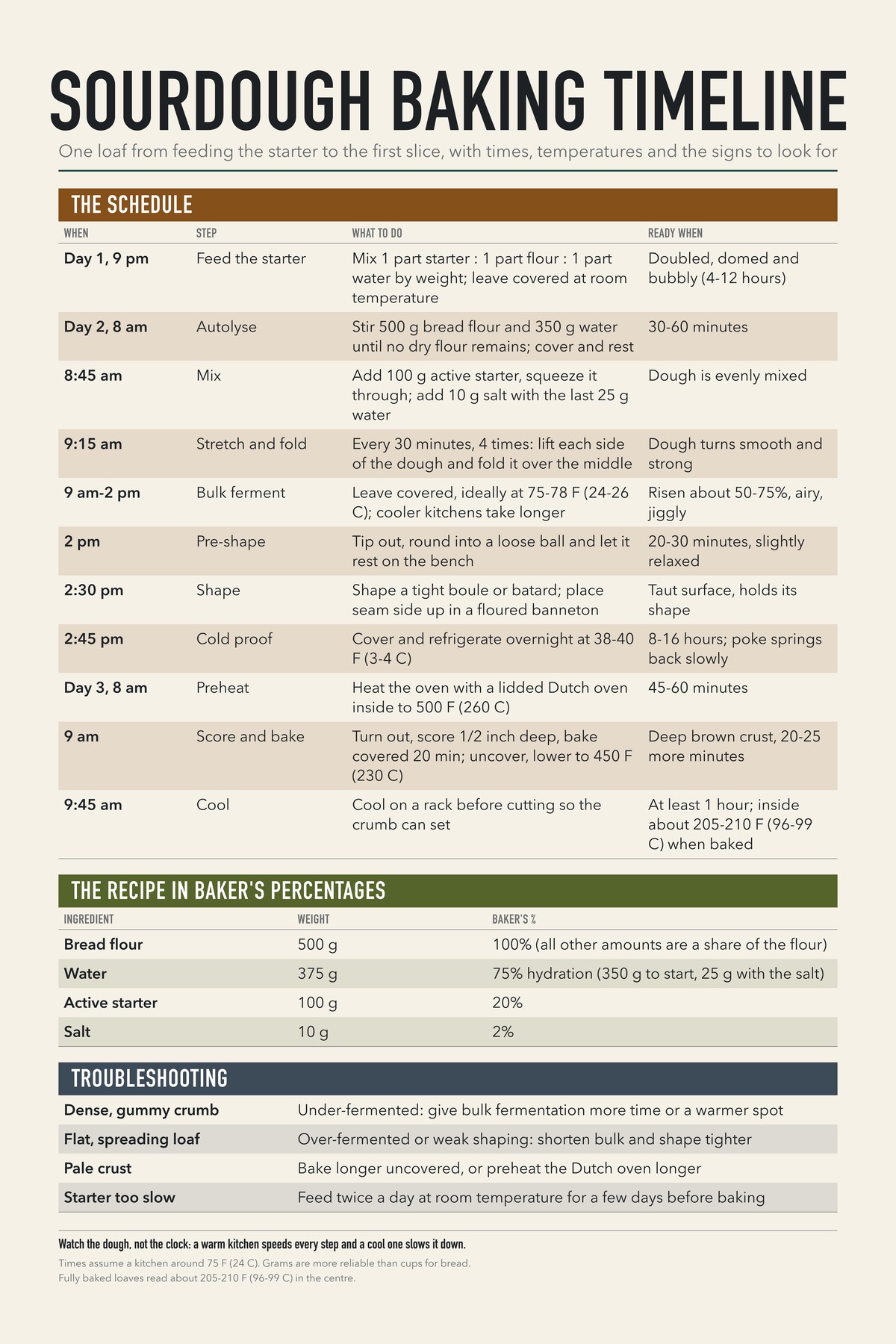
A sourdough loaf takes about a day and a half from feeding the starter to the first slice, but most of that time the dough is resting. This timeline sets out each step with a clock time, what to do and how to tell it is ready, with the recipe in baker's percentages and fixes for common problems.
This chart is on its way to our print shops. Our posters are listed on Zazzle, TeePublic and Threadless (links at the top of this page); browse the kitchen and classroom charts to see the ones already available.
One loaf from feeding the starter to the first slice, with times, temperatures and the signs to look for.
| When | Step | What to do | Ready when |
|---|---|---|---|
| Day 1, 9 pm | Feed the starter | Mix 1 part starter : 1 part flour : 1 part water by weight; leave covered at room temperature | Doubled, domed and bubbly (4-12 hours) |
| Day 2, 8 am | Autolyse | Stir 500 g bread flour and 350 g water until no dry flour remains; cover and rest | 30-60 minutes |
| 8:45 am | Mix | Add 100 g active starter, squeeze it through; add 10 g salt with the last 25 g water | Dough is evenly mixed |
| 9:15 am | Stretch and fold | Every 30 minutes, 4 times: lift each side of the dough and fold it over the middle | Dough turns smooth and strong |
| 9 am-2 pm | Bulk ferment | Leave covered, ideally at 75-78 F (24-26 C); cooler kitchens take longer | Risen about 50-75%, airy, jiggly |
| 2 pm | Pre-shape | Tip out, round into a loose ball and let it rest on the bench | 20-30 minutes, slightly relaxed |
| 2:30 pm | Shape | Shape a tight boule or batard; place seam side up in a floured banneton | Taut surface, holds its shape |
| 2:45 pm | Cold proof | Cover and refrigerate overnight at 38-40 F (3-4 C) | 8-16 hours; poke springs back slowly |
| Day 3, 8 am | Preheat | Heat the oven with a lidded Dutch oven inside to 500 F (260 C) | 45-60 minutes |
| 9 am | Score and bake | Turn out, score 1/2 inch deep, bake covered 20 min; uncover, lower to 450 F (230 C) | Deep brown crust, 20-25 more minutes |
| 9:45 am | Cool | Cool on a rack before cutting so the crumb can set | At least 1 hour; inside about 205-210 F (96-99 C) when baked |
| Ingredient | Weight | Baker's % |
|---|---|---|
| Bread flour | 500 g | 100% (all other amounts are a share of the flour) |
| Water | 375 g | 75% hydration (350 g to start, 25 g with the salt) |
| Active starter | 100 g | 20% |
| Salt | 10 g | 2% |
| Dense, gummy crumb | Under-fermented: give bulk fermentation more time or a warmer spot |
| Flat, spreading loaf | Over-fermented or weak shaping: shorten bulk and shape tighter |
| Pale crust | Bake longer uncovered, or preheat the Dutch oven longer |
| Starter too slow | Feed twice a day at room temperature for a few days before baking |
Watch the dough, not the clock: a warm kitchen speeds every step and a cool one slows it down.
Times assume a kitchen around 75 F (24 C). Grams are more reliable than cups for bread.
Fully baked loaves read about 205-210 F (96-99 C) in the centre.